
Introduction
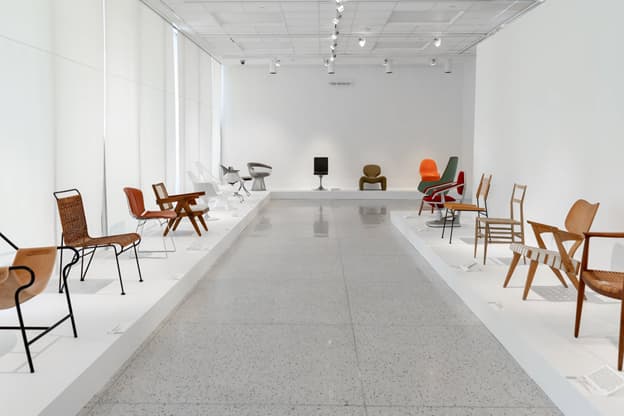
Palm Springs Art Museum has reopened the Architecture and Design Center, Edwards Harris Pavilion with the exhibition The Modern Chair.
September 9, 2021 – April 3, 2022
This special exhibition will follow a timeline of the development of the modern chair starting with the famous Thonet "B-9" bentwood armchair (circa 1905), which is widely considered the first modern chair. Le Corbusier frequently used it in his early architecture as there was no other modern furniture readily available at the time.
The Modern Chair will trace the evolution from the first cantilevered example by Mart Stam, and then onward to designs of current times including examples by Cini Boeri, Charles and Ray Eames, Frank Gehry, Eileen Gray, George Nakashima, Charlotte Perriand, Rudolph Schindler, among many others.
Technological and stylistic advances pushed chair design forward at a breakneck speed in the 20th century like no other time before. The exhibition will also contain important examples of 21st century as well.
Drawn in part from the rich collection of Palm Springs Art Museum, the exhibition will also include key loans from noted collectors and collections. In total, The Modern Chair will include more than 50 works by designers of international scope.
DESIGN
Sometimes, a chair is more than something to sit on. It might be a work of art or a precious heirloom with great sentimental value. To a collector, it could be a trophy object, while others may value its familiar and reliable comfort.
The Womb Chair was the pinnacle of design, beautiful in form and function and embodying modernism's spirit of experimentation and innovation. Seventy-five years later, it's a midcentury classic, with Knoll reproductions and a variety of knockoffs still in high demand.
Although it's not included in The Modern Chair, the season-long exhibition at the Palm Springs Art Museum Architecture and Design Center, Saarinen is represented by his iconic Tulip Chair. The show, drawn from museum's collection as well as from other public and private collections, continues through April 3, 2022, and features 60 eye-popping and comfy-looking specimens spanning more than 100 years.
"During the last century," says curator Brad Dunning, "new industrial materials and technological and stylistic advances pushed chair design forward faster than at any previous time."
It begins with two early examples — a simple and unadorned bent wood Thonet B-9 armchair created in 1904 and used in the designs of architect Le Corbusier as well as the first cantilevered chair created by Mart Stam — and continues through the "fertile and innovative" midcentury years and concludes with contemporary designs.
Visitors can trace the history of the cantilever chair from Stam to the diminutive Rudolph M. Schindler example commissioned by Herman Sachs for the Manola Court Apartments in Silver Lake, and find many familiar designs, such as the Charles and Ray Eames' molded plywood Side Chair (Model DCW).
Innovative entries reflect technological advances and aim to solve problems. Saarinen's Space Age and single-legged Tulip Chair, for example, resolved what the Finnish-American designer described as the "ugly, confusing, unrestful world" underneath tables and chairs.
Panton has a second work in the exhibition: his bright red Heart Cone Chair. He designed it in 1958, based on his striking Cone Chair. The heart-shaped form of its seat shell, also molded as a single piece, inspired the chair's name.
Terje Ekström offers one of the most unusual forms in the playful and ergonomic Ekstrem armchair, created in 1972, commercialized in the 1980s, and now experiencing a revival. Its spider-like design was an instant hit for its odd look and imaginative versatility.
One of Dunning's favorites in the exhibition is the Module 400 chair by French designer Roger Tallon. It has a cast aluminum pedestal base and egg crate latex foam seat and back.
Materiality plays an important role in the exhibition, which includes two chairs constructed with paper, including Frank Gehry's Beaver Chair and Ottoman, designed in 1980 and produced by Vitra in 1987.
More delicate, at least in appearance, is the Honey-Pop Armchair by Tokujin Yoshioka, who formed wafer-thin sheets of paper into a honeycomb design to create a strong structure.
Other chairs in the exhibition, like Danish designer Hans Wegner's Round Chair, became popular in part because of the people who used them. This piece gained worldwide publicity in September 1960, when Richard Nixon and John F. Kennedy sat for the first nationally televised presidential debate.
A few chairs might ring familiar to visitors, including Eames' classic 670 and 671 Lounge and Ottoman — "The design for this chair has never gone out of production and remains a bellwether of success and status," Dunning says.
Some are artful, like Gerrit Rietveld's Red Blue Chair, which epitomizes the Dutch de Stijl aesthetic pioneered by Piet Mondrian and Theo van Doesburg.
Others, like Cini Boeri's glass Ghost Chair, will surprise. "Boeri wanted a chair that just disappeared," Dunning explains. "Of course, it doesn't, but it's less than a half-inch thick of poured sheet glass."
Visitors to the show might be tempted to pick up Italian designer Gio Ponti's Superleggera chair. Its name translates to "superlightweight," as it weighs only 3.7 pounds but can support the weight of a 350-pound person.
In the center of the exhibition space, Dunning has organized a section to focus on California design that includes William Haines' Custom Armchair (circa 1950), as well as a wicker example by Miller Lee Fong.
The California section also includes examples by the Eames duo, such as the popular Rocking Shell Chair, as well as Richard Neutra, Paul Tuttle, Luther Conover, Daniel Wenger and several underappreciated women.
The Modern Chair makes no attempt to be comprehensive; rather, it's a survey exhibition that showcases the evolution of design over more than a century. "So much of design is cyclical and transitory," Dunning says, "but a lot of the chairs that we're showing are in the design zeitgeist now."
Tags