
Introduction
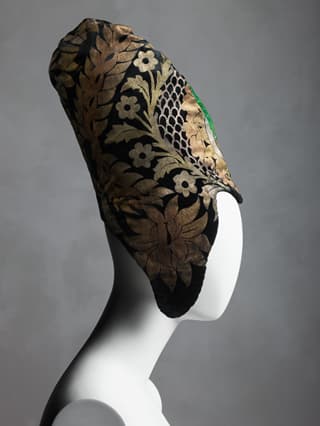
Working in the early decades of the twentieth century, Italian designer Maria Monaci Gallenga captivated contemporaries with her luminous and richly patterned textiles, which were the basis for striking women's fashions as well as elements of interior design.
Beginnings in Rome
Gallenga's upbringing and early experiences in Rome laid the foundation for a career grounded in admiration for Italy's artistic past and a desire to nurture a broader creative community. Born in 1880 to a well-established family embedded in Rome's vibrant cultural life, she became interested in the history of art and design at an early age. During her teenage years she experimented with painting on textiles and eventually began creating garments from fabrics she designed.
Coming of age in a period of increased attention to the history of textile design, Gallenga had access to recently published studies on the subject, which not only encouraged her fascination with antique fabrics but also became sources of inspiration for her own designs. She was also shaped by larger concerns that emerged following Italy's recent political unification, particularly the desire to stimulate international interest in Italian decorative arts and to define an autonomous artistic identity for the country.
When Gallenga launched her career in the early 1910s, she would have been familiar with fashion and textiles by the house of Fortuny, founded in Venice in 1906. Under the direction of Spanish-born Mariano Fortuny and his French-born wife and design partner Adèle Henriette Nigrin Fortuny, the Fortuny studio became an important site of experimentation in textile design and production.
The first significant display of Gallenga's work, which included textiles, shawls, and cushion covers, came in 1915 at Secessione Romana, one of a series of annual exhibitions that took place in Rome between 1913 and 1916. In 1918 she opened her first shop in Rome featuring her own designs as well as glassware, metalwork, ceramics, sculpture, tapestries, and embroidery by emerging and established Italian artists.
International Growth
Gallenga's engagement with the Roman art world led to her participation in international expositions that brought greater attention to her work. At the 1915 Panama-Pacific International Exposition in San Francisco, she exhibited a range of womenswear that included mantles, tea gowns, tunics, and stoles primarily of silk velvet or crepe printed with metallic pigments. For these she was awarded a grand prize and gained acclaim in the American press.
Interest in Gallenga's fashions grew in the United States, where they were appreciated for their blend of antique design motifs and coloration with modern fashion silhouettes. By the following decade, her designs were available in cities throughout the country, including Boston, Chicago, New York, and San Francisco.
As her career reached its peak during the 1920s, Gallenga continued to expand her international reach. In 1925 she participated in the Exposition Internationale des Arts Décoratifs et Industriels Modernes in Paris, showcasing furnishing textiles, garments, and accessories in her signature prints. Following the Paris exposition, Gallenga opened a boutique in the heart of the city, creating a salon-like environment highlighting her own work alongside decorative arts by a rotating roster of Italian artists.
Among her clientele were European aristocrats, socially prominent Americans such as Elsie de Wolfe, and internationally known actresses Lynn Fontanne and Lillian and Dorothy Gish.
Design and Production
Gallenga's marriage of printed patterns with garment silhouettes was responsible for the success of her designs. Like her glistening motifs, the cut of Gallenga's fashions often referenced medieval and Renaissance dress. The fluid lines of these earlier styles aligned with the designer's preference for unrestrictive clothing and harmonized with the columnar silhouette that dominated high fashion during the 1910s and 1920s.
Gallenga's production process likewise blended tradition and innovation, as she embellished modern industrially made fabrics with hand-worked techniques. By developing her own method for metallic printing on textiles—different from that used at Fortuny—she was able to achieve more subtle shading and a greater range of tones within a single motif.
To execute these signature details, Gallenga devised a system of printing wherein designs were cut from thin wooden sheets that were then mounted to sturdier support blocks. These lightweight components could be created quickly and economically within her own workshop, giving her control over the process. To create her brilliant prints, adhesive was applied to the custom-made blocks, which were then pressed to the surface of the textile. Powdered metallic pigments were then brushed by hand onto the treated areas.
Unlike their Renaissance counterparts, Gallenga's fabrics retained a supple hand, well suited to modern fashions, thanks to the flexibility and lightness of her adhesive and pigments. She did not generally produce preprinted lengths of fabric that could then be made into clothing or accessories. Instead, her printing was executed after the fabric was cut to shape for a specific design, ensuring that the placement of the printed pattern complemented the cut of the finished garment.
Final Years
Like many designers catering to American and European clients, Gallenga's business suffered in the Great Depression, and this, in addition to her failing health, led her to scale back her activities. Closing her Paris boutique in 1934, she returned to her original shop in Rome, where she shifted her focus to textiles for use in interiors. When she retired in 1938, her son took over the business, which continued to specialize in interior design until its closure in the late 1970s.
Tags