
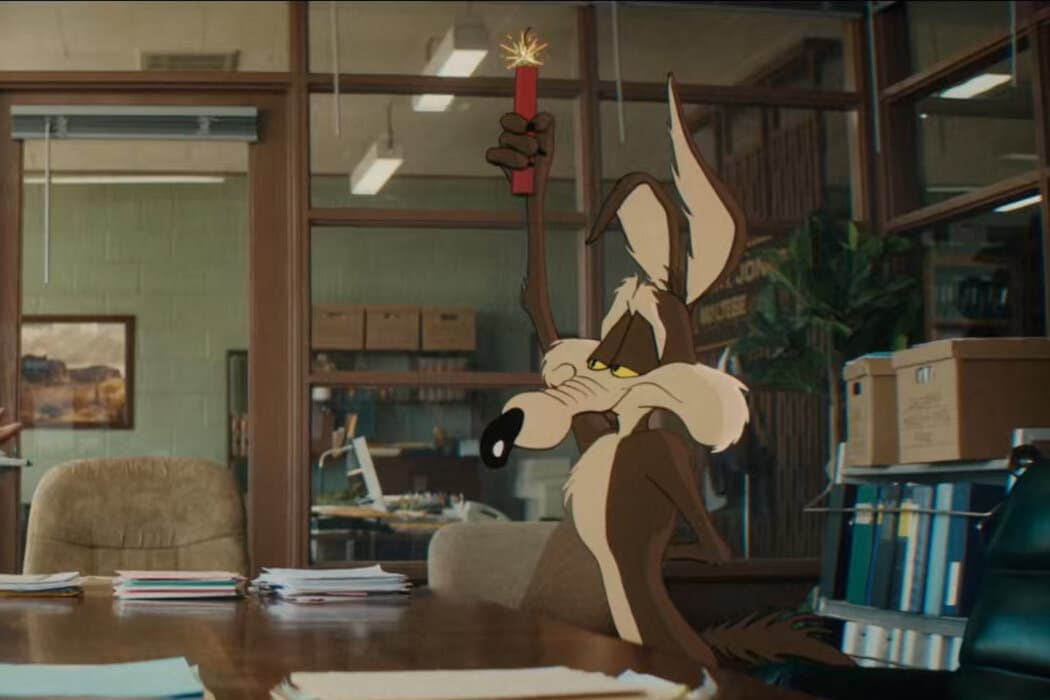
A Cartoon in the Real World
In Coyote vs. Acme, Wile E. Coyote stays a hand-drawn cartoon while everyone around him is a live actor in a real room. Director Dave Green chose this on purpose: a photorealistic coyote would have hidden the story point that ACME exists in both the human world and the cartoon world.
That choice put the set decorators at the center of the film. Every room had to be believable for the people in it, and still leave space for an animated coyote to be added later.
SET DECOR, the magazine of the Set Decorators Society of America (SDSA), interviewed Set Decorator Wilhelm Pfau SDSA about how he and Production Designer Steve Arnold dressed the film's sets in New Mexico and Washington, DC. Some sets are a direct nod to the classic cartoons, and others are rooted in the real world. Here are the highlights, with photos courtesy of Ketchup Entertainment.
Designing Around the Animation
Pfau joined the film when Steve Arnold called him just as he finished another show. The two found right away that they had similar experience and a similar eye.
The team always knew that animation would be added to each scene. Dave Green shared drawings and a previs video that showed where Wile E. would appear. The decorators often left areas of a set empty for the animators, and in other shots the animation was laid over the physical dressing. Pfau says it was fun to imagine what the final shot would look like.
A Wile E. puppet stayed on set so the actors had the correct eyeline when they spoke to him. He even had his own chair, and he spent breaks and lunch with the crew.
Kevin's Law Office
Kevin Avery's law firm, Avery, Jones & Maltese, sits in a strip mall. The exterior and the interior were shot at the same location, an abandoned building that the construction crew had to make workable. The team had the building for two to three months, and most of the businesses around it were empty, so it felt like a stage.
The office keeps the vintage feel of the cartoons. It also had to show how unsuccessful Kevin is and how much chaos surrounds him. After the first photos, the team went back and added much more clutter.
The mismatched chairs in the conference room tell the story at a glance: Kevin takes little pride in his work. Pfau also likes the asymmetry. "The real world is not perfect and in order," he tells his crew.
A Mid-Century Motel
Kevin lives in a motel, which says a lot about his life. Albuquerque has many beautiful mid-century motels, and the team used one on Central Avenue near downtown. They painted the building, cleaned up the pool, and carried the mid-century style inside and out.
For the interiors, the team looked for pieces with a whimsical feel to match what the animators would add. The standing lamp in the lobby looks as if a Chuck Jones drawing became three-dimensional.
Wile E.'s Room
Kevin's room and Wile E.'s room were built on a stage. At first, Wile E.'s room is an exact reverse of Kevin's room next door, down to a hidden ironing board.
Then the fun began. The team imagined everything Wile E. would collect and searched Northern New Mexico for it. They even found a rocket in someone's backyard. After a few visits to his cave, the room becomes Wile E.'s workshop, and it grew over several days of shooting as the team added pieces.
Pfau worked closely with Prop Master Keith Walters. He also credits his buyers, Scott Clark, Anthony Whitman and Jesse Coffer.
The Explosion
Wile E. finally goes too far and blows a hole into Kevin's room next door. When the shooting crew left, the set decorators tore the room to pieces. They built the aftermath before the special effects explosion was filmed. Then the animators at WAG added their drawings on top.
ACME: White With Pops of Red
ACME had to be a big contrast to the worlds of Kevin and Wile E. Red is the ACME color all through the classic shorts, so the team built a crisp white world with pops of red.
Finding a completely white office suite for the evil lawyer Buddy Crane was a challenge: white desks, white pens, white monitors, white chairs, white vases and a white conference table. Pfau describes the conference room as a place where nothing lives. Look for the sculptures, too: a coyote with a dynamite detonator in the headquarters and a rocket in the conference room.
The ACME Labs
The ACME labs are completely different. The research scientist Dr. Lorre, a character based on the actor Peter Lorre, comes from another era, so the team dressed the labs to match him. Albuquerque prop houses with good collections supplied the antique lab equipment and office dressing.
Dr. Lorre's Secret Lab
Dr. Lorre also has a private lab under the house he shares with his devoted wife, Granny. We never see him there, because ACME keeps him prisoner underground. The set still had to show how he worked.
Small portable steps sit along the counters. They are a simple, quick way to show his short stature, so you can picture him at work without seeing him. This set also left a lot of open space for the animators.
Granny's House
Pfau loves the story of Dr. Lorre and Granny, and he wanted their home to reflect their relationship. The team chose a location that mirrors the Granny's House that cartoon fans know. It was a good start for a Victorian feel and for the comfortable plumpness of Granny's character. Look closely and you will find Tweety's cage, or cages.
The Courthouse and the Carrot Festival
The trial at the heart of the story plays out in a New Mexico courthouse that the team built on a stage. Judge Troppogrosso, played by Luis Guzmán, uses a cartoon mallet as his gavel. The film also visits a Carrot Festival, a huge outdoor set that appears both by day and at night.
An Underdog Story
For Pfau, the best part of the film was that every set was completely different. He had to come up with something new every day, and the work was never boring. He calls the production a big collaboration that made a funny and moving film.
He also sees the film's story in its path to theaters. It is an underdog story, pun intended, and many good people worked hard to make sure that Wile E. got his day.
Why It Matters for Interior Designers
Set decoration uses the same tools that interior designers use every day: color, furniture, layout and the small details that tell you who lives in a space. Coyote vs. Acme is a fun example of how a room can show a character's success, values and history at a glance.
Read the full interview with Wilhelm Pfau SDSA and see every set photo on SET DECOR.
Tags

