
Introduction
In San Francisco's Alamo Square, Jensen Architects turns to the past to boldly reinterpret a storied historic home.
John Conomos, an established San Francisco builder and president of Drömhus General Contractors, was living with his family opposite Alamo Square when the Victorian next door went on the market. Although not apparent from its dingy exterior, the home was closely connected to the architectural preservation of the city itself. Living in the adjacent Edwardian—historic in its own right—Conomos and his wife Amanda had zero intention of moving. However, after fearing the possibility of a future buyer carelessly leveling the dwelling in favor of a nondescript mansion, they couldn't escape the responsibility of restoring the home to its full potential.
The home had quite a story of its own. In the 1950s, Verta Vinson, a prominent local figure and one of the founders of the Alamo Square Neighborhood Association, was living with her husband in an apartment fronting the park. Vinson was a vocal advocate for the preservation of the city's Victorians at a time when the San Francisco Redevelopment Agency had their eyes on Alamo Square with plans for demolition.
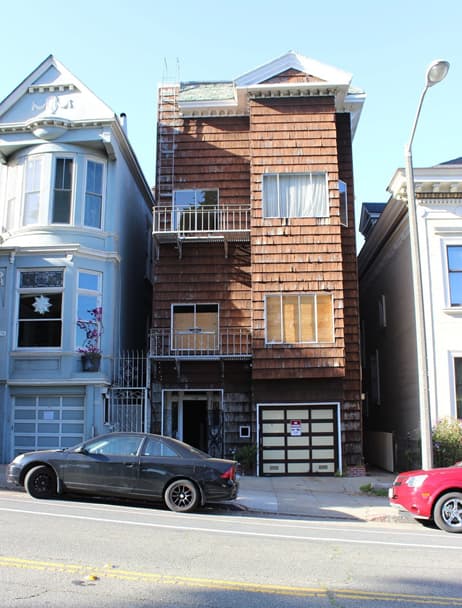
The historic residence had been severely disfigured over the years. Originally built in the Victorian Stick style in 1889, which would have included intricate trims and moldings, the home had seen numerous confounding facelifts in its lifetime. The facade was stuccoed over at one point, and subsequently blanketed in brown shingles.
The home needed a complete overhaul, and the couple soon enlisted Jensen Architects to help reimagine the unique property. The team inherited a host of challenges, the most pressing of which was the muddled exterior, which no longer retained any historic integrity. After careful consideration and a historical evaluation of the building's past lives, the team decided to recreate the original facade.
To lead the ambitious undertaking, the team turned to Skeeter Jones, founder of Clearheart Fine Design and Building. As both a carpenter and artist, Jones has restored countless Victorians across the city, which has become his artistic passion. Jones' process at the Alamo Square residence hinged upon both historic evidence and creative improvisation.
Deviations from the original facade, although subtle, were thoughtful and strategic. Perhaps most notably, the street level bay window was omitted in favor of a garage—a functional necessity. They also incorporated trim that's thicker and more prominent at the bottom, especially at the entry, for a more formidable look.
From start to finish, the laborious facade reconstruction took five months to complete. Once perfected, it was time to select the exterior color, a decision that would have a big impact on the home's presence in the historic neighborhood. The team eventually settled on one color: a semi-reflective silver, whose nuanced metallic sheen is most evident up close.
When the team turned their focus to the interior of the home, a vision unfolded that would prove to be a bold counterpart to the Victorian facade. Through design iterations, a critical shift happened that would inform the trajectory of the project. "We were developing it as if we were going to live in it," says Conomos of the home, "so one day, we decided, okay, let's live in it!"
One of the most distinguishing design elements, the sculptural staircase, immediately commands attention upon entering the home. Clad in fumed and stained oak, the stairs are folded and contorted through the vertical space in an impressive display of architectural origami. Though a sculptural work of art, the stair was initially designed as a light well in order to meet the utilitarian need of maximizing light into the home.
Due to the stair's complex asymmetry and tricky articulation, the final design took multiple renderings to get it right. Once designed, fabrication and construction also proved challenging. The engineered European oak was treated with a custom finish by Hayasa Flooring Design and meticulously installed.
The team inherited soaring ceilings that were original to the home, with heights reaching more than 11 feet on the second and third floors. When Conomos popped his head into the attic after initially purchasing the home, he noticed there were another seven vertical feet to the top of the pitch, presenting a unique opportunity to extend the third-floor ceiling height even further.
While navigating decisions about the home's overall layout, a reverse floor plan was favored, with social spaces localized at the top of the home to take advantage of the best light and views, and the bedrooms at the bottom. The open kitchen anchors the third-floor social space, abutting the family room and sun room. The kitchen space, largely stark and muted, gets an unexpected pop of color at the center island, with teal cabinet fronts and coordinating counter stools.
The home's kitchen features dual Miele ovens, a Thermador refrigerator and freezer, and a Thermador induction cooktop. A feature wall clad in natural Carrara marble sits behind sliding cabinet uppers.
Interior designer Holly Hulburd of Hulburd Design closely collaborated with the team in assembling a design palette that would complement—not compete with—the home's unique architecture. Throughout the home's interior, materials and furnishings have clean lines and a minimal aesthetic.
The home's private spaces have "everything you need and nothing more," according to Conomos. The rear-facing master bedroom, not exceptionally large, was designed that way intentionally. "The whole point of the house was to be among people—no hiding away," says Conomos.
With a blank slate for the home's non-historic and dilapidated rear facade, there was creative freedom to push the envelope. The Jensen team pitched the unconventional idea of a rear facade composed of metal. The elaborate composition took final form as a series of laser-cut aluminum screens that would be movable on motorized sliders.
The team made the most of the "postage stamp-sized" backyard with the help of landscape architects Surfacedesign, who assembled a pattern of pavers that would be graphically interesting to look at. The living wall, by Habitat Horticulture, helps green the backyard in an organic and graphic way.
The vertical projections of the new stair penthouse and elevator penthouse were well within the height limits dictated by the city. The restored parapet on the front facade helps obscure the modern additions from public view, which is necessary for the project's compliance. The outdoor space on the roof, however, was tricky to lay out within the context of the home's surrounding programming.
In the end, the Alamo Square Residence is seemingly a house of contradictions: new and old, traditional and contemporary, muted and bold, simple and innovative. Beneath the surface, however, the disparate elements are woven together with a cohesiveness that allows it to be, at its core, a warm and functional family home.
Tags